

It turns out, our noses can filter many allergens, pollutants, smoke and germs almost as well as a standard air purifier. Discover the microscopic measurements of everyday irritants, and the protective filtration ratings of the nose, mouth, masks and room filters.
Scientists have found that the nose can generally filter particles larger than 0.5 microns. A standard HEPA room air purifier is rated to filter 0.3+ microns, the U.S. Department of Energy standard. And the highest rated face mask, the N-95, has a bottom limit of 0.1-0.3 microns, according to the National Industrial Hygiene Association.
Look at these two graphics.
First, a plot from the U.S. Environmental Protection Agency that shows the sizes of common particles.
The second version below shows the same plot with an overlay of the filtration limits of the nose, standard air purifiers and N-95 masks onto the original chart.
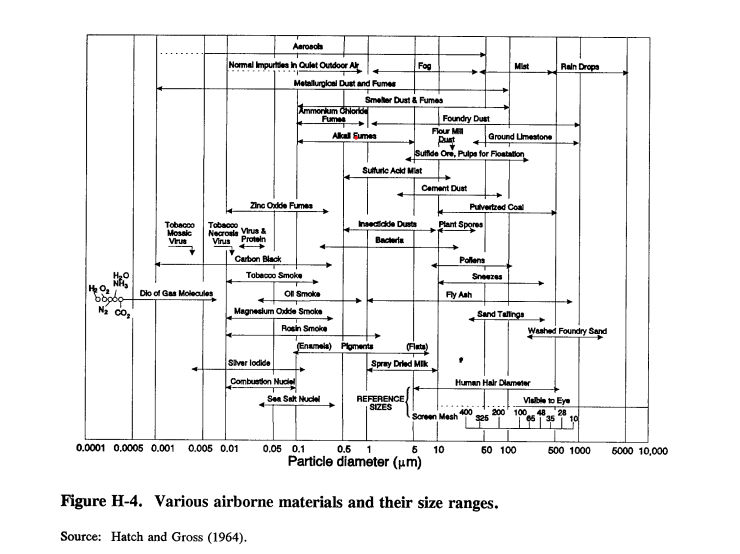
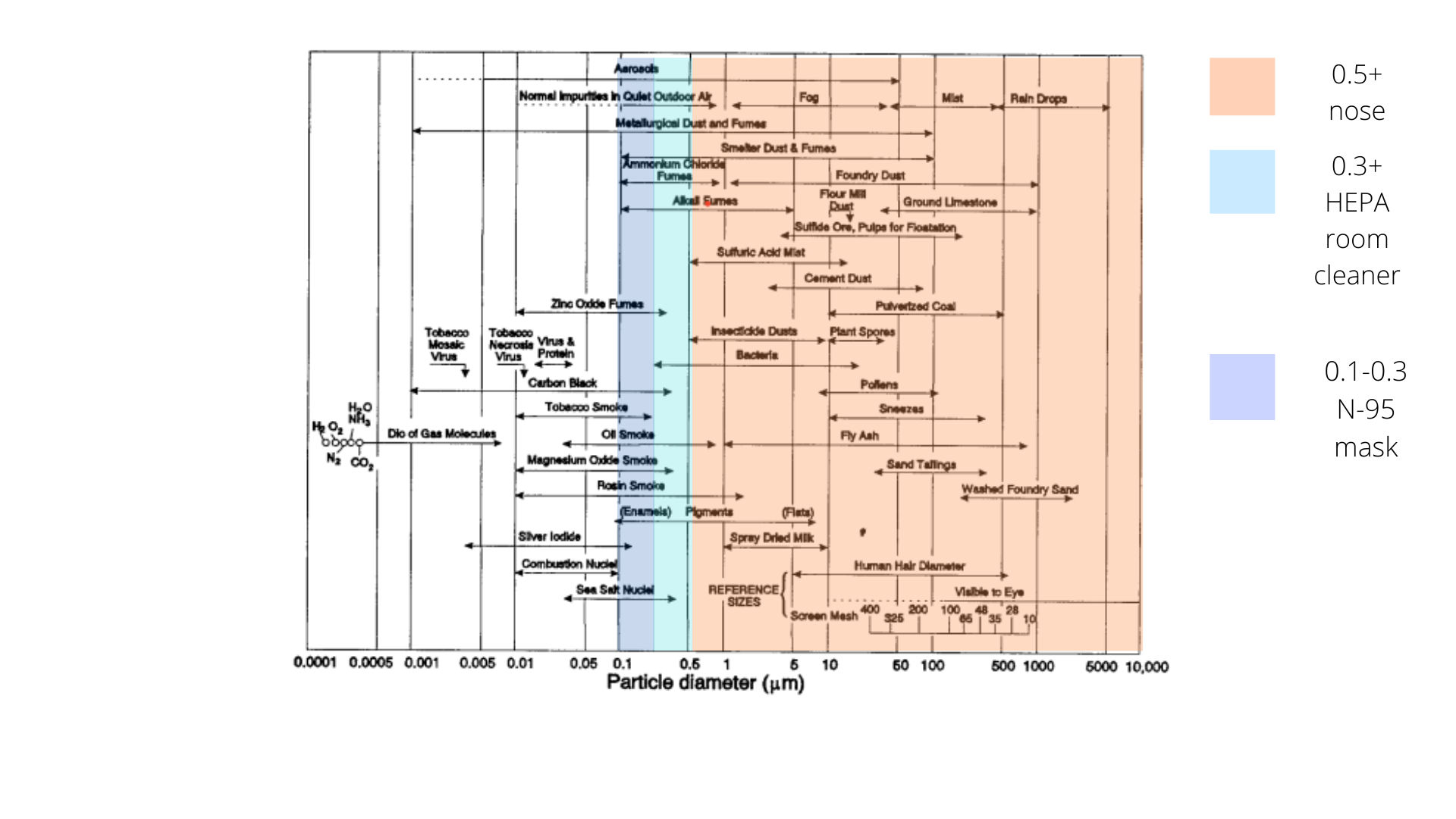
Particles larger than 0.5 microns include pollen, pet dander, human sneezes, antiperspirant, asbestos, auto emissions, copier toner, mold, mold and plant spores, smoke from synthetic materials and some dust, according to The Engineering Toolbox and the EPA.
Particles smaller than 0.5 microns include tobacco smoke, smoke from the burning of natural/organic materials (ie forest fires), viruses and products of combustion. Gas is not a particle but is in the category of elements we cannot shield ourselves from easily.
Smoke and dust in general come in many sizes and are hard to categorize. This is true too of bacteria. They all range from microscopic to visible, so they are included in all categories.
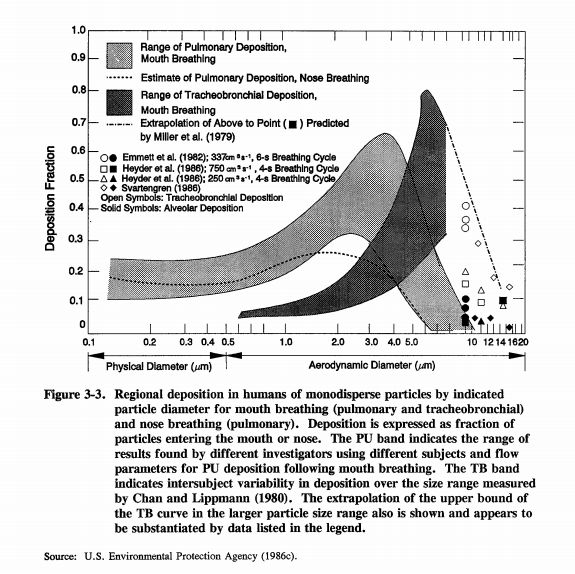
Here is an EPA graphic that demonstrates more particles are inhaled with mouth breathing than nasal breathing.
The main sources for these videos are:
Laryngoscope. 1998 Jan;108(1 Pt 1):120-4. doi: 10.1097/00005537-199801000-00023. https://pubmed.ncbi.nlm.nih.gov/9432080/
US EPA Methods for Derivation of Inhalation Reference Concentrations and Application of Inhalation Dosimetry (particle sizes and nasal/mouth breathing differences): https://www.epa.gov/risk/methods-derivation-inhalation-reference-concentrations-and-application-inhalation-dosimetry
The Engineering Toolbox:
https://www.engineeringtoolbox.com/particle-sizes-d_934.html


